


Focus on Reviewing Business Portfolios
My approach is value investing: buying “strong” companies at “cheap” prices.
I believe that discrepancies between stock prices and corporate value are corrected over the medium to long term, and companies with true strength have high potential to increase their intrinsic value.
This philosophy has shaped my performance over the past 20 years.
As of the end of September 2025, the assets under management for the Japan Strategic Value Strategy, which I oversee for both domestic retail investors and overseas institutional investors, total approximately 510 billion yen.
I view highly of companies that clearly set ROE (Return on Equity) targets and are actively reviewing their business portfolios or engaging in structural reforms of their corporate organization.
These companies demonstrate management that is conscious of and responsive to investors.
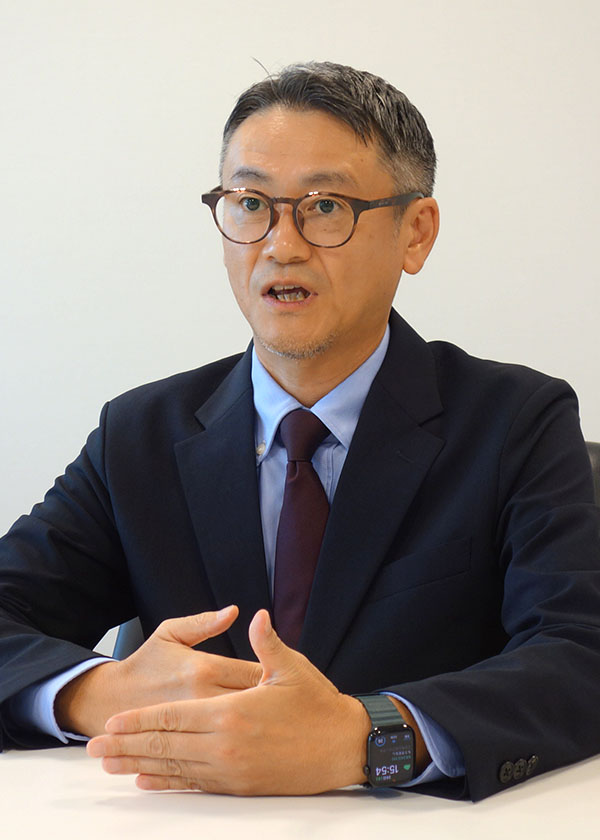
Investment Division
Japan Equity Active Group, Value Team Chief Portfolio Manager
Yoshihiro Miyazaki
I want companies to place importance on giving investors a sense of “understanding and conviction.”
Even if a company’s current PBR (Price-to-Book Ratio) is 0.8, as long as they can clearly explain why it has not reached 1.0 and present a step-by-step plan showing how and by when they aim to achieve their target, it becomes easier for us to consider continuing our investment.
From the perspective of assessing the feasibility of a company’s growth strategy, I focus on the governance framework.
In particular, the “skill matrix” is a useful tool for examining management’s strategic capabilities.
Generally, the vertical axis lists the names and positions of board members, while the horizontal axis includes areas such as “Corporate Management,” “Global Business,” “Audit & Legal,” “Finance & Accounting,” “DX,” “Human Capital Strategy,” and “Sustainability.”
For each board member, marks indicate the fields in which they possess expertise and a track record, and where significant contributions to management are expected.
By using a skill matrix, a company’s information disclosure becomes more convincing—e.g., “There are many directors with expertise in global business. Their policy to double overseas revenue in the next 10 years seems credible.”
It serves as an important indicator to validate the seriousness and effectiveness of the company’s stated growth strategy.
During an investor meeting with an entertainment company, the session ran overtime, and an executive-level participant was asked to leave the meeting room just like any other employee.
I was surprised by the flat organizational culture.
However, it left a positive impression.
In the entertainment industry, where creative thinking is vital, I found it valuable to see firsthand that the company had an open and transparent organizational environment.
Overseas investors place great importance on the resolve of management.
Rather than vague goals such as “a 30–40% increase in sales within the next 10 years,” companies should demonstrate a stance that leaves no room for retreat—for example, “We will increase sales by 1.5 times in three years.”
It is also desirable to simplify explanations of business portfolios.
Even if a company has eight segments, organizing them into three groups makes the message easier for investors to understand.
Horizontally Formatted Integrated Reports That Are Easier to Read on PC Screens
While many companies now publish integrated reports, the growing “template-like” similarity in structure and content is concerning.
Since many investors review integrated reports on PCs, a landscape-oriented format—similar to presentation slides—may be easier to read.
Changing from the traditional vertical format to a horizontal one also provides an opportunity for companies to refine and differentiate their content.